Anna Zanghì is a researcher at the Fondazione IRCCS Istituto Nazionale dei Tumori in Milan, where she investigates early detection and intervention in thoracic oncology. We had the pleasure of interviewing Anna as part of the EATRIS Italy Spotlight Programme. Through the Spotlight Programme, we will showcase Italy’s scientific excellence and capabilities, including promising research conducted by young researchers.
Tell us a bit about yourself
I graduated in Biotechnology from the University of Piemonte Orientale in Novara, Italy, in 2019, where I investigated BAP1 and PD-L1 protein expression in atypical and anaplastic meningiomas. I then obtained a Master’s degree in Medical and Pharmaceutical Biotechnology from the University of Pavia, focusing on prognostic and predictive biomarkers in circumscribed central nervous system gliomas.
In April 2023, I was awarded a research fellowship at the Fondazione IRCCS Istituto Nazionale dei Tumori in Milan for a project focused on the integration of blood-based biomarkers, radiomics, and artificial intelligence to improve lung cancer risk assessment in screening programs.
In July 2025, I began my PhD at the same Institution. My doctoral research continues my focus on early detection in thoracic oncology, investigating how the tumour microenvironment can aid in lung nodule risk stratification and guide early intervention strategies.
How are you connected to EATRIS?
I am connected to EATRIS through my PhD research at the Fondazione IRCCS Istituto Nazionale dei Tumori (INT) in Milan, one of the founding institutions of A_IATRIS, the Italian national node of EATRIS.
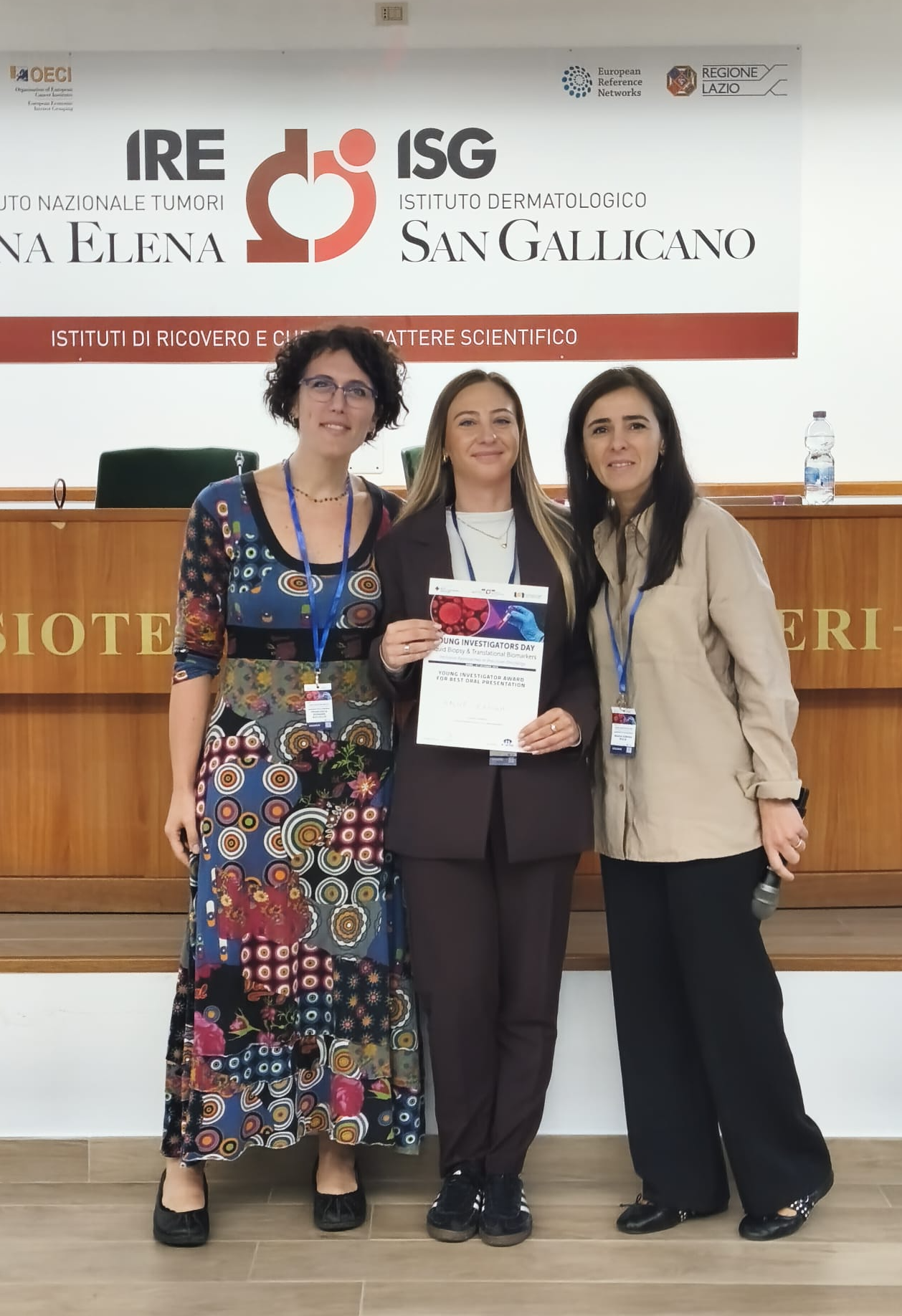
Through this connection, I had the opportunity to participate in the Young Investigators Day on Liquid Biopsy and Translational Biomarkers, held on 6 October 2026 and organised by the Istituto Nazionale Tumori Regina Elena in Rome in collaboration with the IRCCS Istituto Nazionale Tumori Fondazione “G. Pascale” of Naples, within the framework of the A_IATRIS Italian Spotlight initiative.
Receiving the award for Best Oral Presentation was a great honour and an important opportunity to engage with the A_IATRIS and EATRIS communities, expand my professional network, and establish new connections with researchers and clinicians working in translational medicine at both national and international levels.
Anna Zanghì (centre) receiving the award for Best Oral Presentation at Young Investigators Day on Liquid Biopsy and Translational Biomarkers |
What is your current research focusing on, and what’s the potential impact on human health?
Lung cancer remains the leading cause of cancer-related mortality worldwide, making early detection and prevention essential. My group has extensive experience in lung cancer screening, combining blood-based biomarkers with low-dose computed tomography (LDCT) in high-risk individuals, particularly heavy smokers.
My PhD project explores the role of the tumour microenvironment in lung nodule evaluation, focusing on innate immune cells such as macrophages and neutrophils. Specifically, I investigate how macrolide antibiotics might modulate these immune cells and influence the tumour microenvironment in people with suspicious lung nodules.
Alongside this, we aim to refine risk assessment by integrating clinical information, radiomic nodule characteristics, and circulating biomarkers. Combining these multi-modal parameters could enable more personalised screening strategies, with the aim of detecting disease at an earlier stage while sparing patients from unnecessary follow-up procedures.
What challenges do you face in this field, and how do you approach overcoming them?
A central challenge in translational medicine is bridging the gap between laboratory findings and the inherent complexity of human biology. Immune cells can behave differently depending on the individual and the biological context, making it difficult to uncover consistent, clinically meaningful patterns. In my project, this means carefully optimising experimental protocols, accounting for variability in patient-derived samples, and combining molecular analyses with functional experiments.
I approach these challenges step by step, using preliminary results to refine experimental conditions and guide the next stages of the research. Working with both established cell models and primary cells from participants in screening programs also allows me to compare experimental findings with more physiologically relevant conditions.
What future trends or technologies in translational medicine excite you the most, and how might they influence your work?
I am particularly excited about the future of liquid biopsy in oncology. Blood-based biomarkers have the potential to support early detection, monitor disease over time, identify recurrence, and provide information about disease progression through minimally invasive sampling. I believe that integrating these biomarkers with artificial intelligence, radiomics, and immune profiling will be especially valuable for developing more personalised approaches to cancer screening. This is closely aligned with my research. I hope that, as evidence continues to grow, liquid biopsy will become increasingly integrated into clinical practice, helping clinicians make more informed decisions while reducing the need for invasive procedures.
What has been the most rewarding moment in your career as a research scientist so far?
One of the most rewarding experiences of my research career so far was attending the EMBO Summer School Cancer Research: From Fundamental Insights to Clinical Application, held in Spetses, Greece. As my first international scientific meeting alongside PhD students and postdocs worldwide, it offered a great opportunity to exchange ideas, build connections, and gain a broader perspective on the future of oncology.